

Faster Regulatory Compliance
Accelerate implementation of evolving state and federal reporting mandates.
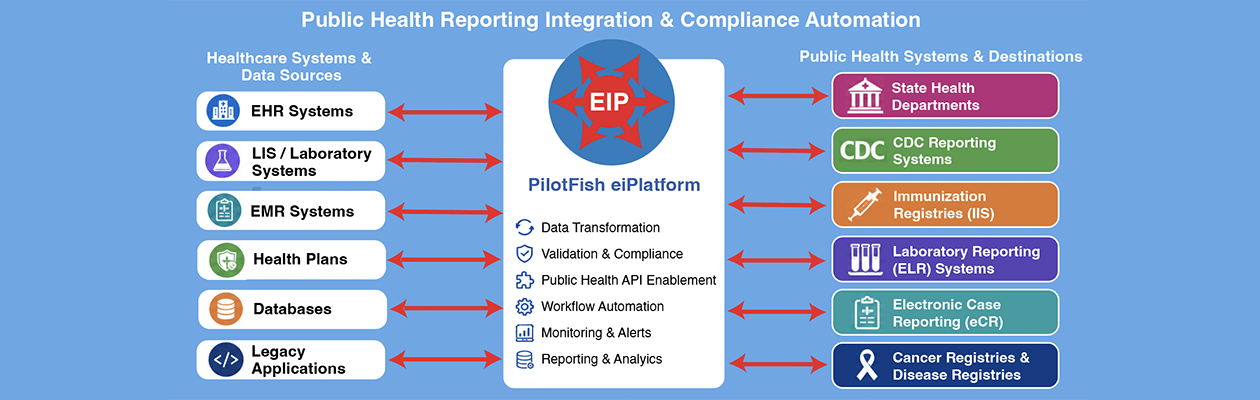
Automate electronic case reporting, laboratory reporting, immunization submissions, syndromic surveillance and public health data exchange and Health Information Exchange (HIE) initiatives using HL7, FHIR, APIs and legacy healthcare systems without disrupting existing operations.
HL7 · FHIR® · ELR · eCR · IIS · Syndromic Surveillance · CDC · State Mandates
Accelerate implementation of evolving state and federal reporting mandates.
Support HL7, FHIR, APIs, C-CDA, ELR, eCR and legacy healthcare systems.

Extend existing investments rather than replacing operational systems.

Reduce manual effort through visual automation and centralized monitoring.
Healthcare organizations must support diverse public health programs, agencies and interoperability standards.



PilotFish enables healthcare organizations to visually configure electronic case reporting, laboratory reporting, immunization submissions and public health interoperability initiatives using reusable workflows and graphical integration tools.
Support HL7, FHIR, APIs, databases, files and legacy applications through a unified integration platform designed for evolving public health requirements.
Unlike traditional integration platforms that rely heavily on custom development, PilotFish enables teams to visually configure public health reporting workflows, data transformations, validation rules and routing logic through reusable drag-and-drop components.
Support electronic case reporting, laboratory reporting, immunization submissions, syndromic surveillance programs and state-specific reporting mandates without building and maintaining custom code.
Public Health Reporting Integration Workflow
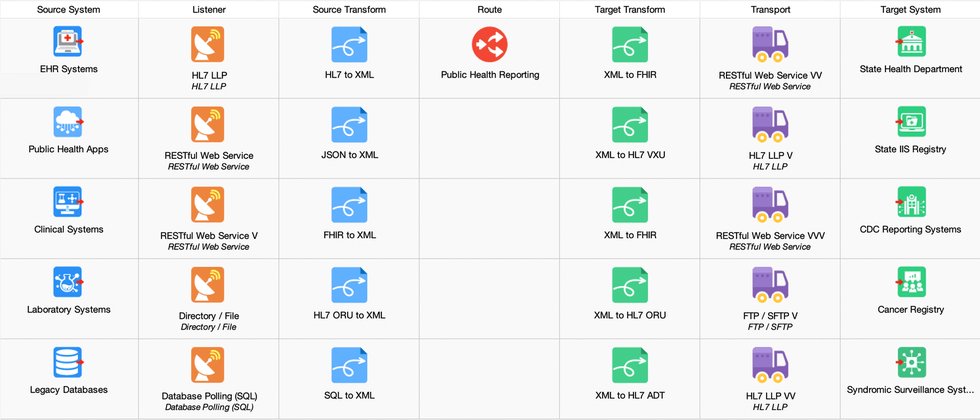
PilotFish provides a complete platform for electronic case reporting, laboratory reporting, immunization submissions, public health interoperability and regulatory compliance automation.
Automate electronic case reporting workflows and support evolving public health reporting requirements.
Connect laboratory systems with state and federal reporting programs using HL7, FHIR and API standards.
Enable secure data exchange with state agencies, registries, CDC systems and modern healthcare platforms.

Validate data before submission to improve quality, reduce errors and support regulatory requirements.
Automate routing, exception handling, scheduling and reporting workflows across public health ecosystems.

Track reporting activity and improve operational visibility across public health workflows.
Accelerate public health reporting initiatives, improve interoperability and modernize legacy healthcare systems without disrupting existing operations.

Accelerate implementation of evolving state and federal public health reporting requirements.

Replace custom coding with visual integration design and reusable workflows.
Support HL7, FHIR, CDA, REST APIs, databases and legacy healthcare systems.

Adapt quickly to evolving public health requirements and reporting standards.
Designed to accelerate public health reporting initiatives, improve interoperability and simplify compliance across evolving healthcare data exchange requirements.
Low-Code Configuration
Visual interface assembly and drag-and-drop mapping simplify public health reporting integrations across HL7, FHIR, APIs, databases and legacy systems.
Reusable Integration Components
Accelerate implementation using configurable workflows, reusable transformations and standardized reporting templates.
Faster Partner Onboarding
Quickly connect healthcare providers, laboratories, state agencies, registries and public health partners without extensive custom development.
Standards-Based Data Exchange
Support HL7 v2.x, FHIR APIs, CDA/C-CDA, REST services, databases, flat files and legacy healthcare applications through a unified integration platform.
Automated Validation
Improve reporting accuracy and data quality through automated validation rules and standards-based processing before information reaches public health agencies.
Data Normalization
Transform and normalize data across disparate healthcare systems to ensure consistent reporting and interoperability outcomes.
High-Volume Reporting Workloads
Support enterprise-scale public health reporting initiatives across real-time and batch processing environments.
Flexible Deployment Options
Deploy on-premises, in the cloud, or within hybrid environments to meet organizational security, compliance and operational requirements.
Lower Long-Term Maintenance
Reduce integration complexity and maintenance effort through reusable assets, centralized monitoring and visual configuration tools.
Support public health modernization initiatives, automate regulatory reporting workflows and simplify interoperability across healthcare ecosystems.
Connect healthcare organizations with major public health reporting programs using standards-based integration and automation.
Automate electronic case reporting workflows using HL7, FHIR and public health interoperability standards.
Support laboratory data exchange with state and federal public health agencies.

Enable vaccine reporting and interoperability with state and regional immunization registries.

Support real-time disease surveillance and public health monitoring initiatives.






“We are excited to partner with PilotFish for our Meaningful Use testing. Managing our providers' attestations has posed a significant challenge. We have hundreds of hospitals and practices vying for our attention as they scramble to meet federally mandated deadlines. In these fiscally challenging times, our employees at DPH are overwhelmed with work. The eiTestBed allows us to eliminate significant human intervention while providing a higher level of service to our healthcare providers than would otherwise have been possible.”
Schedule a personalized demonstration designed around your payer interoperability workflows, FHIR API requirements, healthcare systems and integration environment.
No credit card required · No obligation · Enterprise support included