
Back to Pilotfish Home

CMS Compliance ROI

The Hidden Costs of Noncompliance and How Integration Pays Off

Calculating ROI for Mandate-Driven Integration Investments

CMS compliance requirements continue to expand across healthcare. New mandates now include FHIR APIs, payer-to-payer data exchange, prior authorization, HIPAA X12 transactions and quality reporting. At the same time, advances in AI, automation and analytics are transforming how compliance is monitored and enforced, making gaps, delays and partial implementations easier to detect and harder to justify.

Many organizations still treat compliance as a regulatory expense. In practice, the highest costs often come from delay, underinvestment or short-term solutions that cannot withstand continuous, technology-driven scrutiny. As CMS expectations shift toward production-grade interoperability, compliance increasingly functions as an operational capability rather than a one-time obligation.

Here we outline the real financial and operational impact of noncompliance and contrast it with the measurable return of investing in a modern healthcare integration platform built for CMS interoperability mandates.


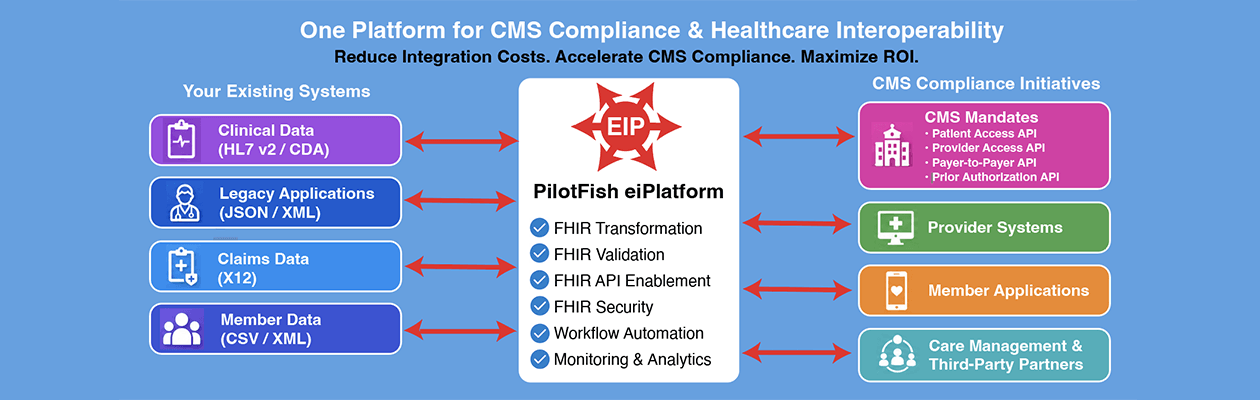
CMS compliance ROI chart showing integration cost savings


The Real Cost of Doing Nothing

Delaying or avoiding compliance may appear cost-effective at first. Over time, it introduces financial risk, operational strain and long-term technical debt.

Regulatory Penalties and Enforcement Risk

CMS mandates are enforceable requirements. Organizations that fail to comply face:

  • Civil monetary penalties
  • Corrective action plans with aggressive timelines
  • Increased audit exposure
  • Risk to participation in CMS programs

As enforcement increases, CMS expectations focus on production-ready integrations rather than pilots or partial implementations.


The Compliance Landscape Is Changing with Faster Detection, Less Tolerance

AI-Driven Scrutiny and the End of “Good Enough” Compliance

CMS compliance risk is no longer driven solely by audits, complaints or periodic reviews. Advances in AI, automation and data analytics are fundamentally changing how compliance is monitored, detected and enforced.

CMS, contractors and downstream partners increasingly use automated systems to:

  • Continuously analyze transaction patterns and data completeness
  • Detect gaps, delays and inconsistencies across FHIR APIs, X12 transactions and reporting feeds
  • Cross-validate data between payers, providers and CMS systems
  • Flag anomalies that previously went unnoticed in manual or sample-based reviews

This shift dramatically reduces the margin for error. Incomplete implementations, partial pilots and brittle point solutions are easier to detect and harder to defend.


What This Means for Regulated Organizations

As compliance oversight becomes more automated and data-driven:

  • Noncompliance is identified faster and at a greater scale
  • Issues surface in production, not just during audits
  • “Temporary” workarounds become visible liabilities
  • Manual processes and data gaps leave clear forensic trails

Organizations can no longer rely on delayed enforcement, limited oversight or one-time attestations. Compliance is becoming a continuously measured operational capability.


The Long-Term Impact on Cost and Risk

AI-enabled scrutiny raises the cost of underinvestment:

  • Small defects compound quickly across high transaction volumes
  • Operational inefficiencies become measurable and attributable
  • Repeated exceptions signal systemic integration weakness
  • Enforcement actions increasingly focus on architecture, not intent

In this environment, compliance is less about checking a regulatory box and more about proving durable, scalable interoperability over time.

Organizations that invest early in centralized integration, automation and visibility are better positioned not only to meet current mandates but also to withstand future enforcement models that assume continuous compliance by default.


Lost and Delayed Reimbursements

Noncompliance often impacts revenue before penalties occur. Common issues include:

  • Claims rejected due to invalid or outdated transactions
  • Prior authorization delays
  • Incomplete or failed data exchange with partners
  • Manual rework by the billing and operations teams

Small delays quickly translate into meaningful reimbursement losses at scale.


Manual Processes and Operational Inefficiency

Without a scalable integration platform, teams compensate with manual work:

  • Spreadsheet-driven data handling
  • Custom scripts and one-off tools
  • Heavy reliance on consultants
  • Increased operational headcount

These approaches raise costs, increase error rates and slow response times.


Technical Debt and Repeat Reimplementation

Point solutions built only to satisfy a single mandate rarely scale. Over time, they:

  • Break when CMS rules evolve
  • Require redevelopment for each new regulation
  • Lack of centralized monitoring and governance
  • Increase long-term maintenance effort

Organizations end up paying repeatedly for compliance that should have been solved once.


The Cost of Compliance Done Right

A modern healthcare integration platform changes the cost equation. Compliance becomes an infrastructure investment that supports multiple mandates over time.

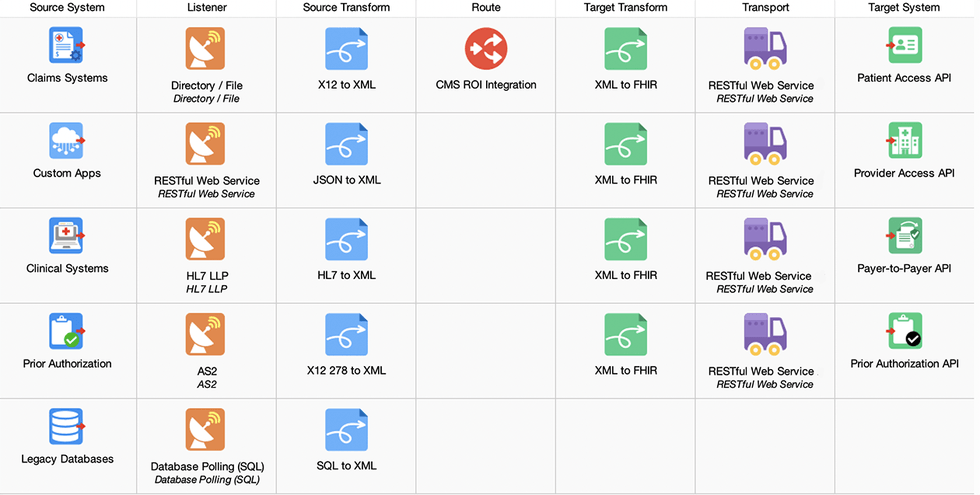
One Platform for Multiple CMS Mandates

A unified platform supports current and emerging requirements including:

  • CMS FHIR APIs for payer-to-payer, patient access and provider access
  • HIPAA X12 transactions such as claims, eligibility, remittance and prior authorization
  • ASTP, HL7 ADT and quality reporting
  • Version control, validation and schema evolution

Each new mandate builds on the same foundation. Marginal compliance cost drops over time.


Lower Total Cost of Ownership

Compared to legacy middleware or custom development, modern integration platforms reduce long-term cost by:

  • Eliminating redundant tools and licenses
  • Reducing custom code and brittle integrations
  • Lowering dependence on external consultants
  • Supporting on-prem, cloud and hybrid deployments

Costs become predictable and easier to manage.


Faster Time to CMS Compliance

Prebuilt healthcare standards support and reusable integration assets allow teams to:

  • Meet CMS deadlines with confidence
  • Respond quickly to regulatory updates
  • Avoid emergency remediation projects

Speed reduces risk and protects revenue.


Improved Visibility and Operational Control

Centralized integration delivers:

  • End-to-end transaction monitoring
  • Automated error handling and retries
  • Audit-ready logging and reporting
  • Dashboards for both technical and business users

This visibility lowers support costs and improves uptime.


Measuring ROI Beyond Compliance

The return on integration investment extends beyond avoiding penalties.

Direct Financial Benefits

  • Avoided CMS penalties and enforcement actions
  • Faster reimbursements and fewer claim denials
  • Reduced integration support and maintenance costs


Long-Term Strategic Value

  • Readiness for future CMS mandates without re-platforming
  • Faster onboarding of payers, providers and partners
  • Improved interoperability across the organization
  • Stronger credibility with regulators and customers

Compliance infrastructure becomes a business asset rather than a constraint.


Why PilotFish for CMS Compliance ROI

PilotFish helps healthcare organizations move from reactive compliance to sustainable integration by delivering:

  • A healthcare-focused integration platform built for CMS mandates
  • Native support for FHIR, HIPAA X12, HL7 and related standards
  • Flexible deployment options across cloud, hybrid and on-prem environments
  • Long-term scalability without repeated reimplementation

The result is lower risk, lower cost and measurable ROI across current and future compliance requirements.


CMS compliance is mandatory. Ongoing rework and revenue loss are not. PilotFish enables organizations to turn mandate-driven integration into durable infrastructure that delivers value well beyond the regulatory deadline.


Take Control of Compliance Costs

CMS mandates will continue to evolve. Organizations that rely on short-term fixes will continue to absorb unnecessary cost, risk and operational disruption. Those that invest in a scalable integration foundation reduce compliance exposure while improving efficiency and long-term readiness.

PilotFish helps healthcare organizations quantify the cost of compliance, reduce total integration spend and meet CMS requirements with confidence.

Ready to evaluate the true ROI of compliance versus inaction? Talk with PilotFish to assess your current integration landscape, identify hidden costs and build a mandate-ready integration strategy that supports both compliance and growth.

Request a Free Compliance Cost and ROI Assessment


FAQs


Mandate-driven integration is building and operating interoperability that meets CMS requirements like FHIR APIs, payer-to-payer data exchange and prior authorization data exchange, while keeping workflows stable as rules evolve. It treats compliance as ongoing infrastructure, not a one-time project.


Two key rules are the CMS Interoperability and Patient Access Final Rule (CMS-9115-F) and the CMS Interoperability and Prior Authorization Final Rule (CMS-0057-F). CMS says CMS-0057-F builds on CMS-9115-F and adds provisions to increase data sharing and reduce burden by improving prior authorization and data exchange.


The payer-to-payer API is the mechanism CMS uses to govern payer-to-payer data exchange, with detailed CMS FAQs on when data must be shared, who is impacted and how edge cases are handled.


Common HIPAA adopted transactions include X12 837 (claims), 270/271 (eligibility), 276/277 (claim status), 278 (prior authorization and referrals), 835 (claim payment and remittance) and 834 (enrollment) plus 820 (premium payment). CMS lists these adopted standards and compliance details under HIPAA Administrative Simplification.


A reusable integration foundation lowers costs by reducing one-off builds, limiting manual rework and supporting centralized monitoring, logging and governance across mandates. Over time, each new requirement builds on the same platform so marginal compliance effort drops.


Check out our FAQ pages for more.


If you’re curious about the software features, free trial, or even a demo – we’re ready to answer any and all questions. Please call us at 813 864 8662 or click the button.

X12, chartered by the American National Standards Institute for more than 35 years, develops and maintains EDI standards and XML schemas.

This is a unique website which will require a more modern browser to work! Please upgrade today!