
Enterprise Healthcare Analytics Integration Platform
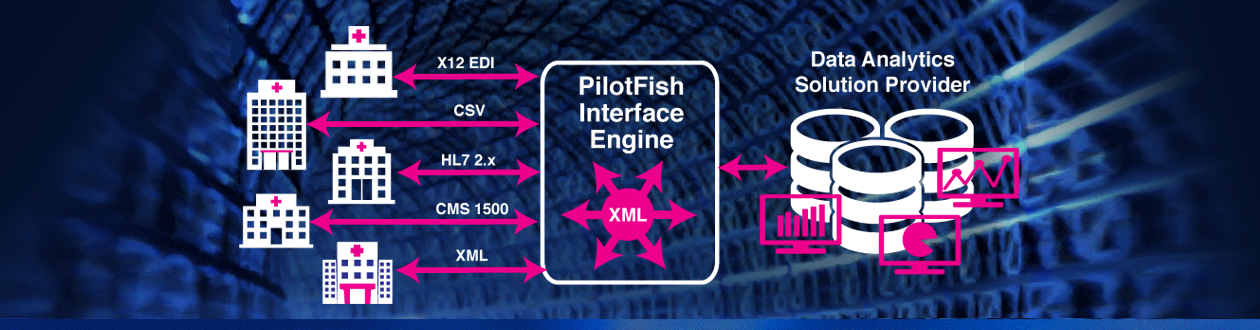
Data Analytics & Reporting Integration
Snapshot
Client Profile
A leading healthcare analytics and reporting organization delivering financial, operational and quality performance insights to hospitals and healthcare providers across the United States.
Integration Challenge
Managing massive volumes of disparate healthcare data while providing accurate, real-time analytics across multiple hospital systems, EHRs and healthcare applications.
PilotFish Solution
Deployment of the PilotFish Integration Platform, including eiPlatform, eiConsole for Healthcare and eiDashboard, to create a scalable, enterprise-grade healthcare data acquisition and interoperability framework.
Key Outcomes
- Unified integration architecture supporting enterprise analytics initiatives
- Real-time acquisition and processing of millions of clinical records
- Faster onboarding of healthcare systems and data sources
- Improved data accuracy, scalability and operational efficiency
- Future-ready interoperability with HL7, FHIR, EDI and emerging healthcare standards
Overview
Healthcare organizations are under increasing pressure to become more data-driven. Financial performance, operational efficiency, quality reporting and patient outcomes now depend on the ability to collect, normalize and analyze enormous volumes of healthcare data in real time.
For one nationally recognized healthcare analytics organization, success depended on delivering a single, trusted source of insight across a rapidly expanding ecosystem of hospitals, physician practices and healthcare networks.
But as the organization grew, so did the complexity of its integration environment.
The company needed to aggregate and process massive volumes of clinical, operational and financial data originating from disparate EHRs, hospital systems and healthcare applications — all while maintaining speed, accuracy and scalability.
Leadership recognized that their existing approach would not support future growth. They needed a modern integration architecture capable of supporting advanced analytics initiatives, accelerating interoperability and adapting to rapidly evolving healthcare standards such as HL7 FHIR.
After a rigorous evaluation process involving many of the industry’s leading integration vendors, the organization selected PilotFish to serve as the backbone of its next-generation healthcare analytics infrastructure.
The Background
Turning Healthcare Data into Actionable Intelligence
The client had established a dominant presence within the healthcare analytics market by helping hospitals and provider organizations transform complex healthcare data into actionable business intelligence.
Its platform delivered:
- Financial performance metrics
- Operational reporting
- Quality measurement analytics
- Benchmarking and comparative insights
- Value-added analytical services for healthcare organizations
To accomplish this, the organization had to continuously collect and process vast amounts of healthcare information from multiple environments and technologies.
The integration landscape included:
- HL7 clinical data
- EDI transactions
- XML and JSON feeds
- Proprietary healthcare formats
- Emerging FHIR-based interoperability workflows
As customer demand accelerated, the organization faced increasing pressure to onboard new systems quickly while maintaining strict data quality requirements.
The company’s leadership understood that healthcare analytics is only as strong as the underlying integration infrastructure. Delays, inconsistencies or incomplete data directly impacted the value of the analytics delivered to customers.
What they needed was not simply another interface engine. They needed a scalable interoperability platform capable of becoming a strategic foundation for long-term growth.
The Integration Challenge
The organization launched an extensive evaluation process involving multiple integration vendors and technologies. The final stage culminated in a competitive “bake-off,” where vendors were required to solve a series of real-world healthcare integration use cases representative of the organization’s production environment.
The technical requirements were substantial:
- Process millions of healthcare transactions and records efficiently
- Support HL7, FHIR, EDI, XML, JSON and proprietary formats
- Normalize data from disparate healthcare systems
- Maintain high-speed, real-time data acquisition
- Deliver enterprise-level scalability and reliability
- Simplify onboarding of new hospital and provider systems
- Avoid vendor lock-in and excessive custom scripting
- Future-proof the architecture for emerging interoperability standards
Equally important was usability.
The organization wanted a platform its internal teams could manage and extend independently without relying heavily on outside consultants or proprietary coding frameworks.
Many evaluated products struggled with flexibility, performance or complexity. PilotFish distinguished itself by successfully completing every integration use case presented during the evaluation process.
The Solution
A Scalable Data Acquisition and Interoperability Framework
Following selection, PilotFish worked closely with the client’s leadership and technical teams to architect a centralized healthcare data integration framework capable of supporting enterprise-scale analytics operations.
The solution included:
- PilotFish eiPlatform
- eiConsole for Healthcare
- eiDashboard monitoring and management tools
Together, these technologies formed a high-performance “data acquisition” framework capable of managing diverse healthcare interoperability workflows in real time.
One of the primary reasons PilotFish was selected was the extensibility of its architecture.
PilotFish’s healthcare integration suite supports virtually every major healthcare standard and format, including:
- HL7 v2.x and HL7 v3
- HL7 FHIR
- CCD and C-CDA
- X12 EDI
- JSON and XML
- NCPDP pharmacy standards
The platform is also system, database and infrastructure agnostic, allowing the organization to integrate across cloud, hybrid and on-premise environments without architectural limitations.
PilotFish solutions architects collaborated directly with the client’s teams throughout implementation, helping define repeatable integration workflows and reusable interface frameworks that accelerated deployment timelines.
Instead of creating brittle, one-off interfaces, the organization gained a reusable integration architecture designed for long-term scalability.
Implementation Experience
Simplifying Big Data Healthcare Integration
One of the most significant implementation advantages was PilotFish’s graphical, configuration-driven integration approach.
Using PilotFish’s Automated Interface Assembly Line and visual Data Mapper, the organization could rapidly configure complex healthcare transformations without extensive scripting.
This allowed teams to:
- Accelerate interface development
- Simplify testing and validation
- Reduce development bottlenecks
- Standardize integration workflows
- Improve consistency across implementations
PilotFish’s reusable architecture also enabled rapid onboarding of additional healthcare systems and customer environments.
As interoperability requirements evolved, the organization could extend workflows rather than rebuild them from scratch.
The PilotFish professional services team maintained close collaboration throughout the engagement — conducting working sessions, mentoring developers and helping establish integration best practices.
This hands-on partnership significantly reduced implementation risk while accelerating adoption across the organization.
Knowledge Transfer and Operational Empowerment
PilotFish placed strong emphasis on enabling long-term self-sufficiency for the client’s internal teams.
Developers participated in structured PilotFish training programs combining product demonstrations with hands-on interface development exercises. This practical approach allowed the organization’s staff to become productive quickly.
The client’s teams rapidly learned how to:
- Build and maintain interfaces independently
- Configure mappings graphically
- Reuse existing interface templates
- Extend workflows for new use cases
- Monitor and troubleshoot integrations internally
PilotFish’s support organization also became a major differentiator.
The client benefited from responsive technical support via phone, email and chat, ensuring implementation momentum remained high and operational disruptions were minimized.
The Benefits
High Performance, Scalability and Future-Ready Interoperability
The new PilotFish-powered integration environment delivered immediate and measurable operational improvements.
The organization gained:
- High-speed processing of millions of clinical records
- Improved data accuracy and completeness
- Faster onboarding of healthcare customer systems
- Greater operational scalability
- Reduced complexity in managing interoperability workflows
Just as importantly, the architecture positioned the organization for future interoperability initiatives involving HL7 FHIR and API-driven healthcare data exchange.
PilotFish’s licensing structure also delivered long-term economic value. Unlike competing solutions, PilotFish avoided costly per-interface, per-connection and transaction-based pricing models that could have significantly increased costs as the organization scaled.
The result was a sustainable integration strategy capable of supporting continued market expansion.
The Future Outlook and Strategic Impact
What began as a search for a better integration engine ultimately became a strategic transformation of the organization’s healthcare analytics infrastructure.
With PilotFish, the organization now operates on a scalable, extensible and future-ready interoperability foundation capable of supporting:
- Real-time healthcare analytics
- Expanded provider connectivity
- HL7 FHIR interoperability initiatives
- Rapid onboarding of new healthcare systems
- Continued growth in healthcare data volume and complexity
Rather than struggling with fragmented interfaces and escalating operational complexity, leadership now has confidence that its integration architecture can evolve alongside the healthcare industry itself.
By combining deep healthcare expertise, reusable architecture and a collaborative customer-first engagement model, PilotFish delivered more than an interface solution — it delivered the interoperability backbone powering the organization’s next phase of innovation and growth.
Since 2001, PilotFish’s sophisticated architecture and innovations have radically simplified how healthcare integration gets done. Today PilotFish offers the most flexibility and broadest support for healthcare integration of any product on the market and is system, platform and database agnostic. PilotFish’s healthcare integration suite includes support for all healthcare data formats (HL7 2.x, HL7 3.x, FHIR, CCD/CCDA, JSON, XML, X12 EDI, NCPDP, etc.) and communication protocols.
PilotFish is architected to be infinitely extensible with our Open API and flexible to meet any integration requirement. PilotFish distributes Product Licenses and delivers services directly to end users, solution providers and Value-Added Resellers. To learn more, visit our Case Studies or specific solutions like HL7 Integration or X12 EDI Integration.
PilotFish Healthcare Integration will reduce your upfront investment, deliver more value and generate a higher ROI. Give us a call at 813 864 8662 or click the button.
X12, chartered by the American National Standards Institute for more than 35 years, develops and maintains EDI standards and XML schemas.