


State of CT DPH Deploys PilotFish’s eiTestBed and Interface Engine to Streamline HL7 Reporting and Meaningful Use Compliance
DPH Replaces Legacy Interface Engine with PilotFish to Enable Automated Certification, HL7 Conformance Testing and Accelerated Provider Onboarding
Organizations that need to onboard large numbers of customers, partners or data submitters, especially in highly regulated environments, can gain powerful insights from how the Connecticut Department of Public Health (DPH) transformed its integration strategy. By deploying PilotFish’s eiTestBed and eiPlatform Interface Engine, the DPH automated testing, certification and data exchange processes across hundreds of healthcare providers. The result? Dramatically reduced onboarding times, seamless handling of HL7 and custom data formats and a scalable, future-ready infrastructure that supports evolving federal mandates and interoperability standards.
THE CLIENT
The Connecticut Department of Public Health (DPH) is the state’s primary public health agency, responsible for protecting and improving the health and well-being of the population. The DPH oversees a wide array of public health programs and services, ranging from infectious disease surveillance and immunizations to health facilities regulation, chronic disease prevention and environmental health.
As part of its mandate, the DPH must coordinate data exchanges across a complex and diverse healthcare ecosystem that includes over 30 acute care hospitals, hundreds of outpatient clinics, practices, laboratories and long-term care facilities, as well as state-run and private public health organizations. Ensuring seamless electronic data exchange among these stakeholders is critical to achieving statewide public health objectives and responding effectively to both ongoing health needs and emergent threats.
Under federal initiatives such as the Health Information Technology for Economic and Clinical Health (HITECH) Act and the Affordable Care Act (ACA), the DPH must also comply with stringent federal mandates for electronic reporting and interoperability. This includes meeting Meaningful Use (now Promoting Interoperability) criteria for public health reporting and fulfilling CDC requirements for syndromic surveillance, immunization submissions and electronic laboratory reporting (ELR)—all of which require conformance with national HL7 standards and secure, reliable exchange of Protected Health Information (PHI).
To fulfill these responsibilities, the DPH required a modern standards-based HL7 interface engine capable of handling public health data exchange across systems while enabling automated provider onboarding and Meaningful Use compliance.
THE CHALLENGE
The task of enabling real-time, standards-compliant data exchange across Connecticut’s diverse healthcare network posed significant technical and operational hurdles for the DPH’s informatics and IT teams. While federal mandates provided a framework for reporting requirements, the practical implementation of these standards was left to state agencies to manage with minimal resources and varying technical capabilities across providers.
Each key requirement presented its own set of challenges:
- Accommodating multiple HL7 versions (e.g., 2.3.1, 2.5)
Healthcare providers throughout Connecticut used different systems and configurations, each generating HL7 messages in slightly different formats and versions. The existing tools lacked the flexibility to easily interpret and process these variations without custom coding, resulting in delays and an increased risk of errors.
- Supporting self-service onboarding and testing for providers
With hundreds of clinics, hospitals and practices needing to report data, manual onboarding and testing placed an unsustainable burden on the DPH team. There was no scalable mechanism to validate incoming messages, certify compliance, or provide real-time feedback without staff intervention.
- Automating certification for Meaningful Use attestation
Under federal regulations, providers had to demonstrate that they could electronically transmit public health data in conformance with national standards. The DPH lacked a streamlined way to automatically test and document this compliance, often resulting in cumbersome back-and-forth communications.
- Integrating with secure transmission platforms like PHINMS
Transmitting PHI to federal systems such as the CDC required secure, validated messaging protocols like the Public Health Information Network Messaging System (PHINMS). Integrating these standards with legacy systems often involved workarounds that added complexity and risk.
- Performing complex data transformations and validation
The DPH needed to standardize data from disparate systems into internal formats (e.g., Maven XML), apply validation rules and maintain detailed audit trails—all without slowing down message flow or requiring manual intervention at every step.
With growing demand from both state leadership and federal partners to modernize these processes, the DPH recognized the need for a flexible, scalable and future-ready integration solution.
THE SOLUTION
To overcome these challenges, the Connecticut Department of Public Health (DPH) selected PilotFish’s comprehensive integration suite, including the eiPlatform, eiConsole and the cloud-hosted eiTestBed, as its new standard for public health data exchange and provider onboarding. What made PilotFish uniquely suited to the DPH’s needs was its architecture and design, which prioritizes flexibility, reusability and ease of use for both technical and non-technical users:
- Architecture-Agnostic HL7 Processing
PilotFish natively supports all versions of HL7 and can handle customized or extended segments without additional coding. Its extensible parsing engine and built-in support for standards like CDA, X12, FHIR and XML made it easy for the DPH to manage current needs while preparing for future data standards.
- Cloud-Based Self-Service Testing with eiTestBed
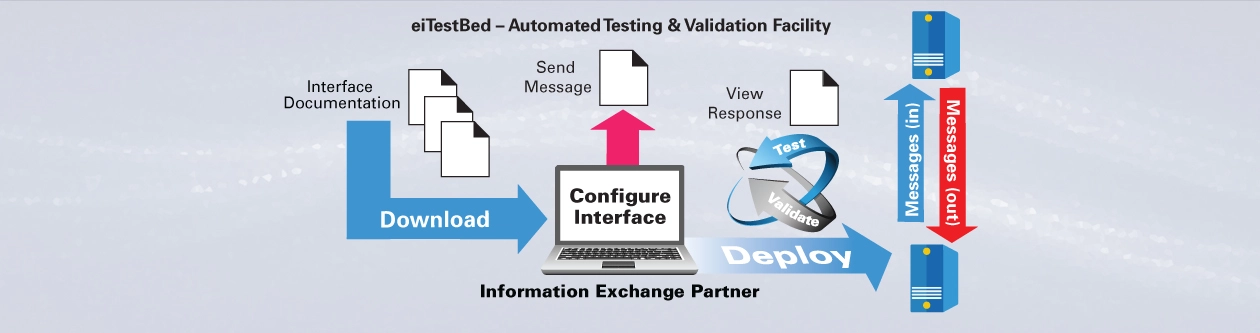
The eiTestBed provides a user-friendly, web-based interface that enables providers to upload HL7 messages, receive automated validation feedback and download certification reports—eliminating the need for DPH staff to manage this process manually.
- Reusable Interface Templates via the eiConsole
PilotFish’s graphical Integrated Development Environment (IDE) in the eiConsole allowed DPH developers to build modular, reusable interface templates. These templates can be quickly cloned and adapted for each new provider or use case, significantly speeding up onboarding.
- Integrated Support for Secure Protocols
The eiPlatform seamlessly supports secure protocols including PHINMS, HTTPS and SFTP, enabling compliant communication with federal partners like the CDC with minimal configuration. Its extensible architecture is designed to support future protocols and evolving standards, ensuring that state remains agile and compliant as new federal mandates and interoperability frameworks emerge.
- Visual Data Mapping and Rule Validation
With PilotFish’s Data Mapper, the DPH team could create sophisticated data transformations using drag & drop visual tools, enabling business users and analysts to participate directly in integration development without deep programming knowledge.
This combination of powerful functionality and intuitive tools allowed the DPH to rapidly replace its legacy engine and roll out scalable new integrations that met both state and federal requirements.
THE BENEFITS
By adopting PilotFish’s integration suite, the Connecticut Department of Public Health achieved a new level of operational efficiency and regulatory compliance in its public health data exchange program.
The DPH realized the following key benefits:
- Faster Onboarding at Scale
Providers can now test and certify their HL7 message submissions without DPH staff involvement, cutting onboarding time from weeks to hours.
- Broader HL7 Support with Minimal Effort
Native, drag & drop compatibility with multiple HL7 versions and custom message formats eliminated the need for manual workarounds or specialized code.
- Automated Certification for Regulatory Compliance
The eiTestBed issues real-time validation and generates certification reports that providers can use to meet federal Meaningful Use attestation requirements.
- Improved Integration with CDC Systems
Built-in support for the CDC’s PHINMS platform and other secure transmission methods ensured compliant communication without complex middleware.
- Accelerated Interface Development
The eiConsole’s reusable templates and visual tools allowed DPH to rapidly build, test and deploy new interfaces with minimal duplication of effort.
- Enhanced Data Integrity and Auditability
Built-in logging, rule validation and audit trail capabilities helped the DPH ensure data quality and maintain transparency for all stakeholders.
- Future-Ready Interoperability Compliance
With the healthcare landscape evolving, PilotFish’s architecture positions DPH to seamlessly adapt to upcoming mandates, such as the CMS Interoperability and Prior Authorization Final Rule (CMS-0057-F), which requires certain provisions by January 1, 2026 and the adoption of the United States Core Data for Interoperability (USCDI) version 3 starting January 1, 2026. Additionally, the system’s flexibility supports integration with emerging standards, such as FHIR, ensuring compliance with future federal and state interoperability requirements.
With PilotFish, the Connecticut DPH transformed a fragmented, resource-intensive integration process into a scalable, automated and standards-compliant system capable of handling today’s reporting demands and tomorrow’s public health challenges. The agency not only replaced outdated tools but also established a future-ready infrastructure that empowers providers to seamlessly participate in statewide data exchange, helping the state move closer to a fully connected public health ecosystem.
Since 2001, PilotFish’s sophisticated architecture and innovations have radically simplified how healthcare integration gets done. Today PilotFish offers the most flexibility and broadest support for healthcare integration of any product on the market and is system, platform and database agnostic. PilotFish’s healthcare integration suite includes support for all healthcare data formats (HL7 2.x, HL7 3.x, FHIR, CCD/CCDA, JSON, XML, X12 EDI, NCPDP, etc.) and communication protocols.
PilotFish is architected to be infinitely extensible with our Open API and flexible to meet any integration requirement. PilotFish distributes Product Licenses and delivers services directly to end users, solution providers and Value-Added Resellers. To learn more, visit our Case Studies or specific solutions like HL7 Integration or X12 EDI Integration.
PilotFish Healthcare Integration will reduce your upfront investment, deliver more value and generate a higher ROI. Give us a call at 813 864 8662 or click the button.
HL7 is the registered trademark of Health Level Seven International.
X12, chartered by the American National Standards Institute for more than 35 years, develops and maintains EDI standards and XML schemas.