
Who Is Impacted?
CMS-0057-F applies to Medicare Advantage Organizations, Medicaid and CHIP managed care entities, state Medicaid agencies, and Qualified Health Plans participating in federally facilitated exchanges.
Understand the CMS Interoperability and Prior Authorization Final Rule, implementation deadlines, impacted organizations, required FHIR APIs, and key compliance obligations for 2026–2027.
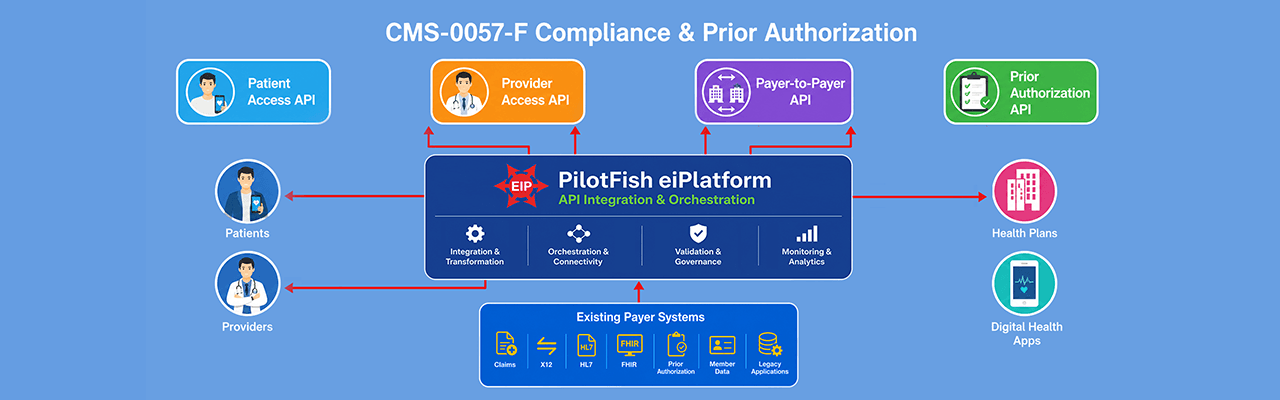
A practical guide to the CMS-0057-F Final Rule covering Patient Access APIs, Provider Access APIs, Payer-to-Payer Data Exchange, Prior Authorization APIs, reporting requirements and implementation timelines.
CMS-0057-F applies to Medicare Advantage Organizations, Medicaid and CHIP managed care entities, state Medicaid agencies, and Qualified Health Plans participating in federally facilitated exchanges.
The rule expands healthcare interoperability through Patient Access, Provider Access, Payer-to-Payer, and Prior Authorization APIs while improving transparency and data exchange across the healthcare ecosystem.
Key operational requirements began in 2026, while major FHIR API implementations, including Provider Access and Prior Authorization APIs, must be operational by January 1, 2027.
Most operational requirements began in 2026. Required CMS-0057-F APIs must be operational by January 1, 2027.
CMS-0057-F requires health plans to implement standardized FHIR-based APIs that improve data accessibility, interoperability, and prior authorization transparency across the healthcare ecosystem.

Enable members to securely access claims, encounter, clinical, and prior authorization information through third-party applications of their choice.
Key Benefits

Allow in-network providers to access member health information from participating health plans to support treatment, care coordination, and clinical decision-making.
Key Benefits

Facilitate the exchange of member data between health plans when individuals change coverage, helping preserve continuity of care and historical health information.
Key Benefits

Automate prior authorization requests, responses, status updates, and supporting documentation exchange using standardized FHIR-based workflows.
Key Benefits
The CMS Interoperability and Prior Authorization Final Rule (CMS-0057-F) modernizes prior authorization workflows through standardized electronic data exchange, improved transparency, faster response times, and FHIR-based interoperability requirements.

Health plans must meet specific response time requirements for prior authorization requests. Expedited requests generally require decisions within 72 hours, while standard requests require decisions within seven calendar days.

Organizations must publicly report prior authorization metrics and performance data. Reporting requirements are intended to increase accountability and improve visibility into authorization processes.

When a prior authorization request is denied, health plans must provide a specific reason for the denial rather than a generic response. This requirement improves transparency and helps providers better understand coverage determinations.

CMS-0057-F requires health plans to implement a Prior Authorization API that supports electronic prior authorization requests, responses, status updates, and the exchange of documentation using FHIR-based standards.
CMS-0057-F interoperability and prior authorization requirements affect multiple healthcare organizations responsible for exchanging, managing, and providing access to healthcare data.

Medicare Advantage Organizations (MAOs), including applicable Special Needs Plans, and Medicare Advantage health plans must support CMS-0057-F interoperability requirements, including Patient Access APIs, Provider Access APIs, Payer-to-Payer APIs, and Prior Authorization APIs.

State Medicaid agencies are responsible for supporting CMS interoperability requirements and enabling secure healthcare data exchange and health information exchange through standardized FHIR APIs and interoperability frameworks.

Medicaid Managed Care Organizations must implement CMS-0057-F API requirements while supporting member access, provider access, prior authorization modernization, healthcare interoperability initiatives, and FHIR API implementation.

Children’s Health Insurance Program (CHIP) managed care entities are included within CMS interoperability requirements and must support applicable API-based healthcare data exchange and interoperability capabilities.

Qualified Health Plans (QHPs) participating in Federally Facilitated Exchanges (FFEs) must comply with CMS-0057-F interoperability mandates designed to improve healthcare transparency, data portability, and electronic access to healthcare information through modern interoperability and FHIR API initiatives.
Health plans and healthcare organizations often face significant technical and operational challenges when implementing CMS-0057-F interoperability and prior authorization requirements.

Many health plans rely on legacy claims, member administration, and healthcare systems that were not designed for modern FHIR APIs, healthcare interoperability, and CMS-0057-F requirements.

Differences among FHIR implementation guides, US Core profiles, Da Vinci specifications, extensions, and API requirements can increase the complexity of interoperability and implementation effort.

Electronic prior authorization workflows require coordination across provider systems, payer platforms, clinical applications, and supporting documentation exchange processes.

Organizations must monitor API performance, prior authorization reporting requirements, healthcare data quality, and evolving CMS interoperability mandates.
Successfully addressing these CMS-0057-F compliance challenges requires a scalable interoperability platform that connects legacy healthcare systems, supports FHIR APIs, automates prior authorization workflows, and provides ongoing compliance visibility.
PilotFish eiPlatform provides a unified interoperability platform for implementing CMS-0057-F requirements. Connect legacy healthcare systems, enable FHIR APIs, automate prior-authorization workflows, and maintain ongoing compliance visibility with a single integration platform.
PilotFish provides the integration, transformation, API enablement, and monitoring capabilities needed to support CMS-0057-F interoperability and prior authorization requirements.

Connect claims platforms, member administration systems, provider applications, databases, files, APIs, HL7 interfaces, and X12 transactions without extensive custom development.

Accelerate implementation of CMS-0057-F interoperability requirements using standards-based FHIR APIs, validation, transformation tools, capabilities, and API orchestration.

Support electronic prior authorization requests, responses, status updates, documentation exchange, and workflow automation across providers and health plans.

Transform and normalize data between FHIR, HL7, X12, XML, JSON, databases, flat files, and proprietary healthcare formats.

Monitor API activity, interoperability workflows, transaction performance, and compliance-related reporting requirements through centralized operational visibility.

Implement Patient Access APIs, Provider Access APIs, Payer-to-Payer APIs, and Prior Authorization APIs from a single integration and orchestration platform.

Accelerate CMS-0057-F projects using visual integration and reusable interoperability components.

Minimize custom coding through graphical configuration, transformation, and orchestration tools.

Support FHIR, HL7, X12, XML, JSON, APIs, databases, and healthcare-specific interoperability requirements.

Adapt to evolving CMS regulations, FHIR implementation guides, and interoperability mandates without major redevelopment.
CMS-0057-F is the CMS Interoperability and Prior Authorization Final Rule that expands healthcare interoperability requirements through Patient Access APIs, Provider Access APIs, Payer-to-Payer APIs, and Prior Authorization APIs.
The rule applies to Medicare Advantage Organizations (MAOs), State Medicaid Agencies, Medicaid Managed Care Organizations, CHIP Managed Care Entities, and Qualified Health Plans (QHPs) participating in Federally Facilitated Exchanges.
Organizations may be required to implement Patient Access APIs, Provider Access APIs, Payer-to-Payer APIs, and Prior Authorization APIs depending on their role and regulatory obligations.
Yes. CMS-0057-F relies on standards-based HL7 FHIR APIs to improve healthcare interoperability, patient access to healthcare information, prior authorization transparency, and payer-to-payer data exchange.
No. CMS-0057-F introduces FHIR-based APIs while many existing X12 transactions remain in use for healthcare administrative and claims-related workflows.
Many operational requirements began in 2026, while required FHIR API implementations, including Provider Access APIs and Prior Authorization APIs, must generally be operational by January 1, 2027.
The Prior Authorization API supports electronic submission of authorization requests, status updates, responses, and supporting documentation using standardized FHIR-based workflows.
PilotFish provides a scalable interoperability platform that connects legacy healthcare systems, enables FHIR APIs, automates prior authorization workflows, and supports ongoing CMS interoperability requirements.
Schedule a personalized demo designed around your data, standards and environment.
No credit card required · No obligation · Enterprise support included